

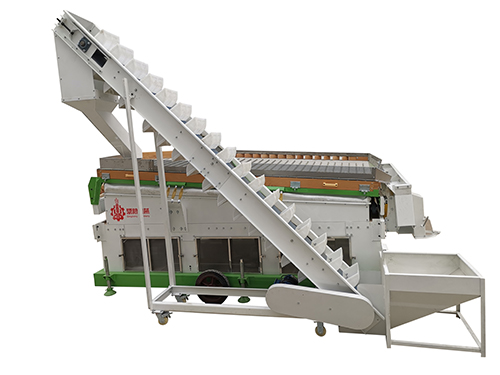
In the field of grain processing and agricultural material handling, impurity removal and screening are key steps to ensure raw material purity and subsequent processing quality. As a mechanical device designed for grains, beans and other materials, the sesame cleaning machine efficiently removes impurities and realizes particle grading through a combination of physical screening and mechanical separation. It is suitable for the primary processing of common crops such as soybeans, wheat, corn, etc.
1. Technical Principle and Core Structure
The machine adopts a double-layer screen design:
The upper screen is responsible for separating large-particle impurities.
The lower screen, through combinations of different aperture sizes, classifies materials into multiple grades according to particle size.
Its power system is driven by a 3 kW motor with a stable speed of 1,440 rpm. The motor drives the screen to vibrate via a belt transmission, creating a high-frequency, small-amplitude screening action.
2. Functional Features and Applicable Scenarios
The core functions of the machine are impurity removal + separation, which can complete impurity elimination and particle grading simultaneously.
The feed inlet is adjustable, allowing users to change the opening size according to material flow to prevent blockage or uneven separation.
The rotating driving device generates centrifugal force to assist fine impurities in passing through screen gaps, improving screening precision.
It has a wide range of applicable materials. In addition to soybeans, wheat and corn, it can also process small-particle crops such as sesame and millet by replacing the screens, meeting the multi-scenario requirements of small and medium-sized processing plants and farms.
3. Operation Key Points and Maintenance Suggestions
Before use, check whether the screens are firmly installed to prevent falling off due to vibration.
After startup, run idle for 1–2 minutes and confirm that the motor and screens are functioning normally before feeding materials.
Control the feeding speed during separation: excessive speed may cause residual impurities, while insufficient speed reduces efficiency.
Daily maintenance focuses on cleaning: remove residues from the screens after each use to prevent clogging. Regularly check the tightness of the motor belt to avoid speed instability caused by slipping.
The machine is packaged with wrapping film. Avoid severe collision during transportation, and store it in a dry environment to prevent rusting of cast iron components.