

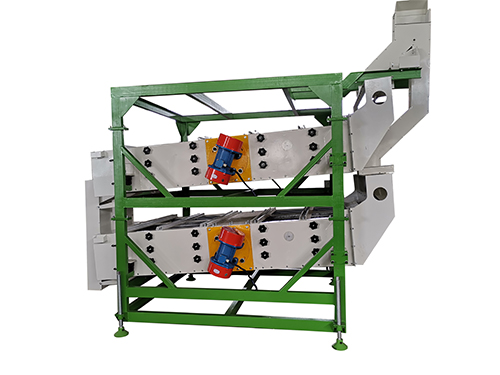
Whether the sieve surface inclination angle of a grain cleaning machine is appropriate shall be comprehensively judged from the material movement state on the sieve surface, cleaning effect, equipment production efficiency and other aspects:
I. Material Movement State
Observe the material flow speed: A proper sieve surface inclination angle enables materials to flow over the sieve surface at a moderate speed. If the inclination angle is too large, materials will slide down rapidly and stay on the sieve surface for too short a time; they may be discharged from the sieve surface before sufficient stratification and separation are completed. If the inclination angle is too small, materials will move slowly and may even pile up, impairing the cleaning efficiency.
Check the material stratification: With a normal inclination angle, materials will be gradually stratified distinctly under vibration and airflow. Heavy‑density materials settle close to the lower end of the sieve surface, while light‑density materials stay near the upper end. An improper sieve surface inclination angle will cause uneven or chaotic material stratification, resulting in poor cleaning performance.
II. Cleaning Effect
Check the removal of light impurities: A proper sieve surface inclination angle helps light impurities be effectively blown to the light‑impurity outlet by airflow. If a large quantity of qualified materials is mixed in light impurities, the sieve surface inclination angle may be excessively large, so that part of heavy materials are also carried away by airflow. If light impurities cannot be thoroughly removed and residual impurities remain, the inclination angle may be too small. In this case, the buoyancy effect of airflow on light impurities is insufficient to realize full separation.
Evaluate the purity of heavy‑density materials: Judge the suitability of the sieve surface inclination angle by testing the purity of materials at the heavy‑material outlet. If excessive light impurities or unqualified particles are mixed in heavy‑density materials, the sieve surface inclination angle is likely unreasonable. Poor material stratification prevents effective separation between heavy‑density and light‑density materials.
III. Production Efficiency
Compare throughput: Under identical other operating conditions, a proper sieve surface inclination angle allows the equipment to deliver high production efficiency, namely the material throughput per unit time meets the design requirement of the machine. If the actual material throughput is obviously lower than the designed value due to improper inclination angle, the sieve surface inclination angle needs adjustment.
Observe equipment operation stability: A suitable sieve surface inclination angle ensures stable equipment operation and uniform stress on all components. Improper inclination angle may trigger abnormal vibration and accelerated component wear, shortening equipment service life and reducing production efficiency.
In practical operation of grain cleaning machines, repeated tests and adjustments shall be carried out according to specific material properties and cleaning requirements to obtain the optimal sieve surface inclination angle for desirable cleaning effect and production efficiency.