

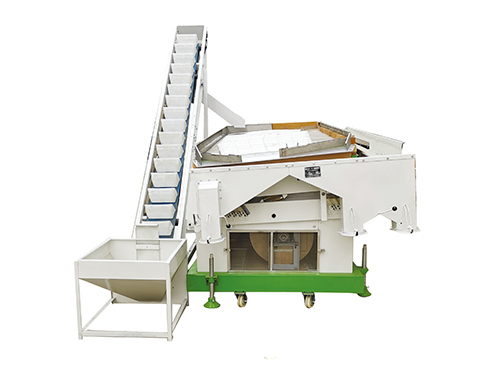
The cleaning efficiency of a grain cleaning machine is affected by multiple factors including material characteristics, equipment parameters and operating conditions, as detailed below:
I. Material Characteristics
1.Particle size distribution
Good uniformity of material particle size prevents the sieve screen of the cleaner from clogging. Airflow and vibration can act more uniformly, facilitating gravity-based separation and delivering high cleaning efficiency. In case of a wide particle size variation, fine particles tend to fill the gaps between coarse particles, hindering airflow passage and material stratification, which reduces cleaning efficiency.
2.Moisture content
High material moisture increases friction between particles, weakens flowability and causes agglomeration. This impedes the movement of materials on the sieve surface and impairs cleaning efficiency. Meanwhile, high humidity may cause light impurities to adhere to heavy materials, increasing the difficulty of separation.
3.Specific gravity difference
A larger specific gravity difference between different components of materials enables easier separation under airflow and vibration, thereby achieving higher cleaning efficiency. If the materials to be cleaned have similar specific gravity, higher equipment precision and more accurate operating parameters are required to realize effective separation.
II. Equipment Parameters
1.Sieve surface inclination
The sieve surface inclination affects the moving speed and residence time of materials on the sieve. An excessively large inclination leads to fast material movement and short residence time; materials may be discharged before sufficient stratification, resulting in poor cleaning performance. An excessively small inclination slows down material movement, lowers production capacity and may cause material accumulation, which impairs cleaning efficiency.
2.Vibration frequency and amplitude
Appropriate vibration frequency and amplitude enable adequate loosening and stratification of materials on the sieve surface. Excessively high frequency or large amplitude causes violent bouncing of materials, making stable stratification hard to achieve. Excessively low frequency or small amplitude fails to fully loosen materials and also reduces cleaning efficiency.
3.Air volume and wind speed of the fan
Air volume and wind speed determine the buoyancy and force exerted by airflow on materials. Excessively high air volume and wind speed will carry heavy materials into light impurities and reduce cleaning accuracy. Insufficient air volume and wind speed cannot effectively blow away light impurities and likewise impair cleaning efficiency.
III. Operating Conditions
1.Feed rate
The feed rate should be moderate and uniform. An excessive feed rate exceeding the processing capacity of the machine causes material accumulation on the sieve surface. Materials cannot be fully stratified and separated, and both cleaning efficiency and performance will decline. An insufficient feed rate results in low equipment utilization and poor production efficiency.
2.Equipment maintenance
Regular maintenance is critical to maintaining the performance of the grain cleaning machine. Unrepaired damage to the sieve screen leads to material leakage or ineffective screening. Unaddressed problems such as dust accumulation on fan impellers and wear of vibrating components will undermine airflow and vibration performance and further reduce cleaning efficiency.