

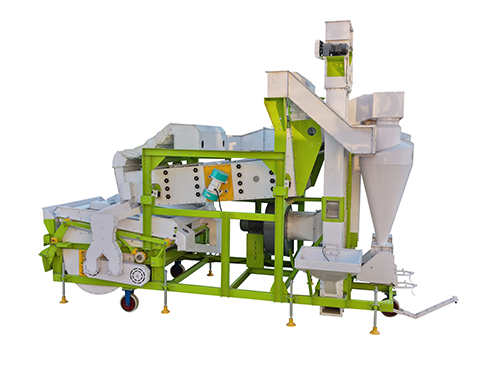
The core working principle of a color sorter relies on differences in optical properties (color, brightness, shape, transparency, etc.) between materials and impurities. It uses photoelectric detection technology to identify and remove off-color or irregular-shaped impurities, achieving precise material sorting.
The process can be divided into five core steps. Different types of color sorters share the same basic framework, differing only in detection technology and actuating components.
I. Core Working Process
1. Uniform Material Feeding
Materials (such as millet, rice, ore, etc.) enter the machine through a hopper. They are then arranged into a single-layer, uniform, and stable flow via a vibratory feeder, chute, or crawler, moving downward or forward.
The key is to ensure materials do not overlap or cluster, so each particle can pass through the detection area individually, avoiding missed or false detections.
2. Optical System Detection and Identification
This is the core stage of the color sorter. The detection unit consists of a light source, image sensor, and background plate:
Light source: Emits stable white, infrared, or ultraviolet light to illuminate the passing materials.
Image sensor: Mainstream sensors are CCD or CMOS, acting as the “eyes” of the sorter. They capture real-time optical images of materials and convert optical signals into electrical signals.
Background plate: Provides a standard reference background to help the sensor clearly distinguish color differences between materials and impurities.
The sensor compares captured images with preset standard parameters (color thresholds, shape features, etc.) to identify non-conforming off-color, moldy, or foreign particles.
3. Signal Processing and Analysis
Electrical signals from the sensor are sent to the main control board for rapid processing using built-in algorithms:
Ordinary CCD color sorter: Judges based on preset color thresholds; particles exceeding the threshold are classified as “impurities”.
AI intelligent color sorter: Uses deep learning algorithms to autonomously learn material features, identifying more complex defects (slight mold, insect damage, translucent particles) and reducing false rejection rates.
The entire analysis is completed within milliseconds, synchronized with the material conveying speed.
4. Precise Impurity Ejection by Spray Valves
When the system identifies an impurity, it immediately sends a command to the corresponding solenoid valve bank.Compressed air from a high-pressure air pump is released through the spray valves as a high-speed air jet. At the moment the impurity passes the ejection zone, it is blown out of the material flow into a waste collection tank.
Qualified materials continue along their original path into the finished product tank.The valve response time is extremely fast (usually within 10 ms), ensuring high ejection accuracy.
5. Separate Collection of Finished Products and Waste
Qualified materials and removed impurities enter their respective collection bins, completing the entire sorting process.