

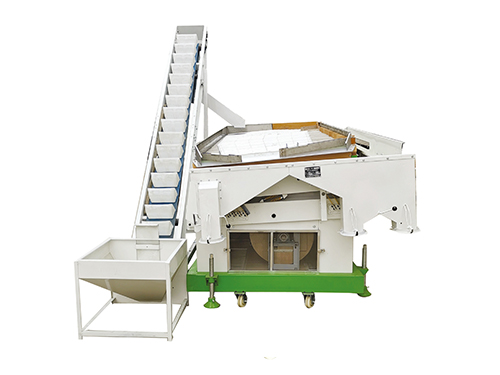
A grain grading machine is a mechanical device used for separating materials based on their particle size, density, or other characteristics. Its working principle and main types are as follows:
1. Working principle:
1. Screening principle: Material is graded according to size through sieves with different pore sizes
2. Principle of airflow separation: Utilizing differences in airflow velocity to separate particles of different densities
3. Centrifugal force sorting principle: Separation of light and heavy materials is achieved through the centrifugal force generated by rotation
4. Gravitational sedimentation principle: Grading based on the difference in sedimentation velocity of particles in the medium
5. Principle of electrostatic separation: Utilizing the conductivity differences of materials to achieve separation in an electric field
6. Principle of magnetic separation: It involves the separation and screening of materials based on their magnetic differences.
II. Main types and characteristics of grain graders:
1) Vibrating screen type: suitable for particle size classification of dry materials, with a large processing capacity but general accuracy;
2) Drum screen type: suitable for primary screening of wet and sticky materials, with simple structure and easy maintenance;
3) Airflow classifier: It can precisely control micron-sized powder, but is sensitive to humidity;
4) Hydrocyclone: It operates efficiently and continuously in a liquid environment with low energy consumption;
5) Centrifugal classifier: It is particularly suitable for the classification treatment of high-viscosity slurry.