

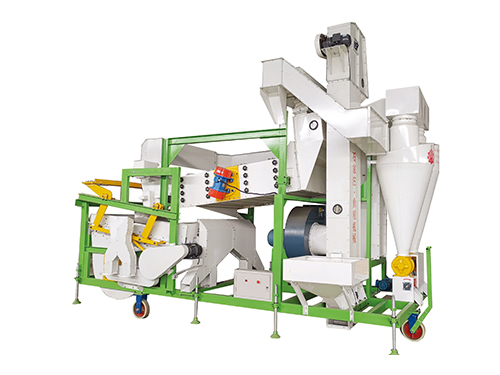
The “material dropping” phenomenon of a grain impurity remover generally refers to abnormal leakage or spilling of materials during conveying, screening or discharging, which not only causes waste but also may affect operation quality. Below are the main causes and corresponding solutions:
1. Worn or Failed Seals
Aging or damaged rubber plates and sealing plates in the cleaning chamber, threshing chamber, header system and other parts will lead to grain leakage through gaps.Solution: Inspect and replace worn seals regularly; temporarily plug leaks with sealant or soft materials.
2. Damaged Sieve Mesh or Sieve Frame
Broken sieve frames, cracked or worn adhesive structures of sieve meshes prevent effective material separation, causing grains to be discharged along with impurities.Solution: Replace the sieve mesh in a timely manner; check whether the sieve frame is deformed or split, and contact professional maintenance personnel if necessary.
3. Improper Air Volume Adjustment
Excessive fan air volume blows grains off the sieve surface; insufficient air volume fails to separate light impurities effectively, resulting in material accumulation and overflow.Solution: Adjust air volume according to crop moisture content and maturity. For example, reduce the opening of the upper sieve to two‑thirds for dry crops, and set the air volume to ensure “no husks in grains and no grains in husks”.
4. Overloaded Feeding Rate
Excessively fast feeding speed exceeds the processing capacity of the cleaning system, causing material accumulation and overflow from discharge outlets or joints.Solution: Match the forward speed with the feeding rate to avoid overloaded operation; ensure the engine speed reaches the rated value (e.g., 2200 revolutions per minute).
5. Air Leakage in Pneumatic Conveying System
For impurity removers adopting air separation or pneumatic conveying, perforated pipelines or loose joints lead to insufficient air pressure and material dropping.Solution: Check the tightness of conveying pipelines, fasten joints or repair leakage points.
6. Improper Adjustment of Reel or Conveying Chute
An excessively high reel or mismatched rotational speed knocks grain heads and causes grain dropping; poor sealing of the conveying chute also results in grain leakage.Solution: Adjust the reel height so that its acting point is two‑thirds above the crop cutting line; inspect and reinforce the sealing of the conveying chute.